Economic Calendar Explained: The Complete Guide for Traders
A complete trader’s guide to the economic calendar—what it is, why markets move on news, how to read Actual vs Forecast, and the mistakes that cost beginners money.
Table of contents
- What Is an Economic Calendar?
- Why Do Markets React to Economic News?
- The Economic Calendar Is a Risk Management Tool
- Not Every Event Matters Equally
- The Four Numbers Every Trader Must Understand
- Previous
- Forecast
- Actual
- Revised
- Why the Difference Between Actual and Forecast Matters
- Looking for real-time economic calendar data?
- Which Markets Respond to Economic News?
- Timing Matters More Than Many Traders Realize
- The Most Common Mistakes Traders Make When Using an Economic Calendar
- Building a Daily Routine Around the Economic Calendar
- Want this calendar inside your product — live?
- The Economic Calendar Is Not a Trading Strategy
- Why Every Serious Trader Needs an Economic Calendar
- Final Thoughts
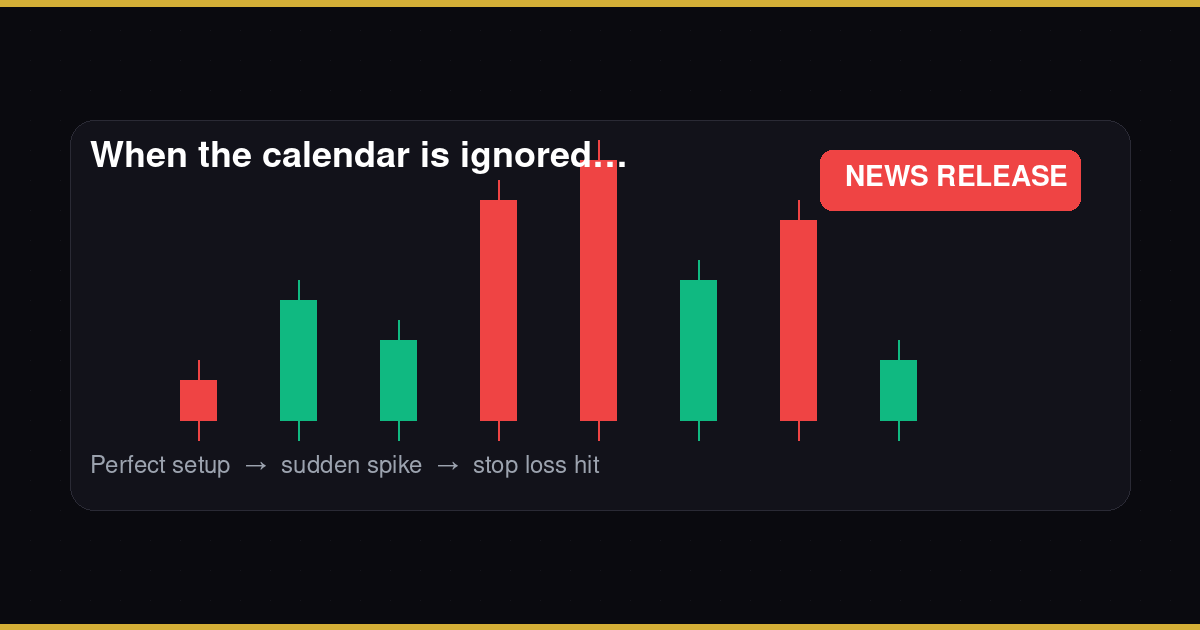
If you've been trading for a while, you've probably experienced this situation.
Your analysis looks perfect. The trend is clear, your entry is well-timed, and the technical indicators all point in the same direction. You enter the trade with confidence.
Then, within a few seconds, the market explodes.
Stock index futures reverse direction without warning. Your stop loss is hit before you even understand what happened.
Many traders blame manipulation, algorithms, or "smart money." In reality, one of the most common reasons is much simpler:
What Is an Economic Calendar?
An economic calendar is a schedule of upcoming economic events, government reports, and central bank announcements that can influence financial markets.
Think of it as the timetable of information that has the power to change market expectations.
Unlike technical indicators, which analyze what has already happened, economic events often shape what happens next.
Every week, governments, statistical agencies, and central banks publish hundreds of economic reports. Most of them have little impact on prices. A small number, however, can move billions of dollars across global markets within minutes.
These events include:
- Inflation reports (CPI and PPI)
- Interest rate decisions
- Employment reports
- GDP releases
- Retail sales
- Manufacturing surveys
- Consumer confidence data
- Central bank speeches
- Minutes from monetary policy meetings
Timing is information
For traders, knowing when these events are scheduled is almost as important as understanding what they mean.
Why Do Markets React to Economic News?
Financial markets do not move because numbers are released.
They move because expectations change.
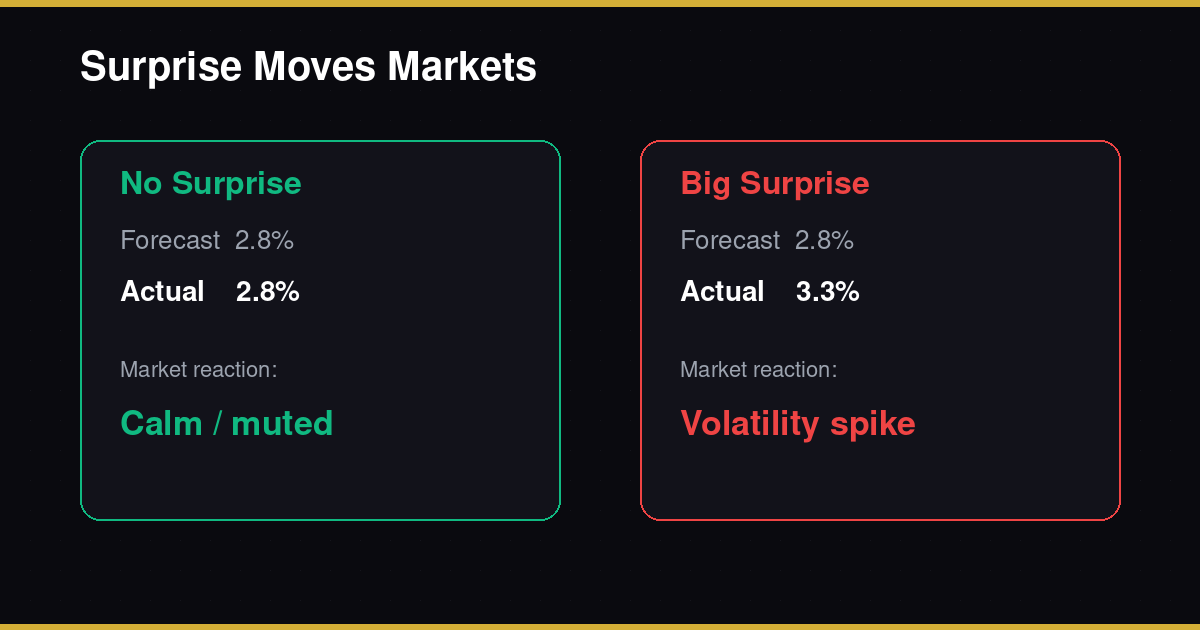
Suppose investors expect inflation to be 2.8%. If the published number is exactly 2.8%, the market may barely react because everyone was already expecting it.
But imagine inflation comes in at 3.4%.
Nothing in the real economy changed during those few seconds. Factories did not suddenly produce more goods. Consumers did not instantly spend more money.
What changed was investors' expectations about future interest rates.
Higher inflation increases the probability that the central bank will keep interest rates higher for longer. That expectation immediately changes the valuation of currencies, bonds, stocks, commodities, and even cryptocurrencies.
Understanding this single idea helps explain why some economic reports barely move prices while others trigger massive volatility.
The Economic Calendar Is a Risk Management Tool
Many beginners think an economic calendar exists to help them find trading opportunities.
Professional traders often use it for the opposite reason: to avoid unnecessary risk.
Imagine you open a position just three minutes before the U.S. Non-Farm Payroll report. The market may remain calm until the exact release time.
Then liquidity disappears. Spreads widen. Slippage increases. Price jumps from one level to another without trading through the prices in between.
Even if your market direction is correct, your execution may be terrible.
Know when not to trade
Professional traders know that preserving capital is often more important than catching every possible opportunity. Many funds reduce exposure before major announcements instead of increasing it.
Knowing when not to trade is frequently a bigger advantage than knowing when to trade.
Not Every Event Matters Equally
One of the biggest mistakes beginners make is treating every economic release as equally important.
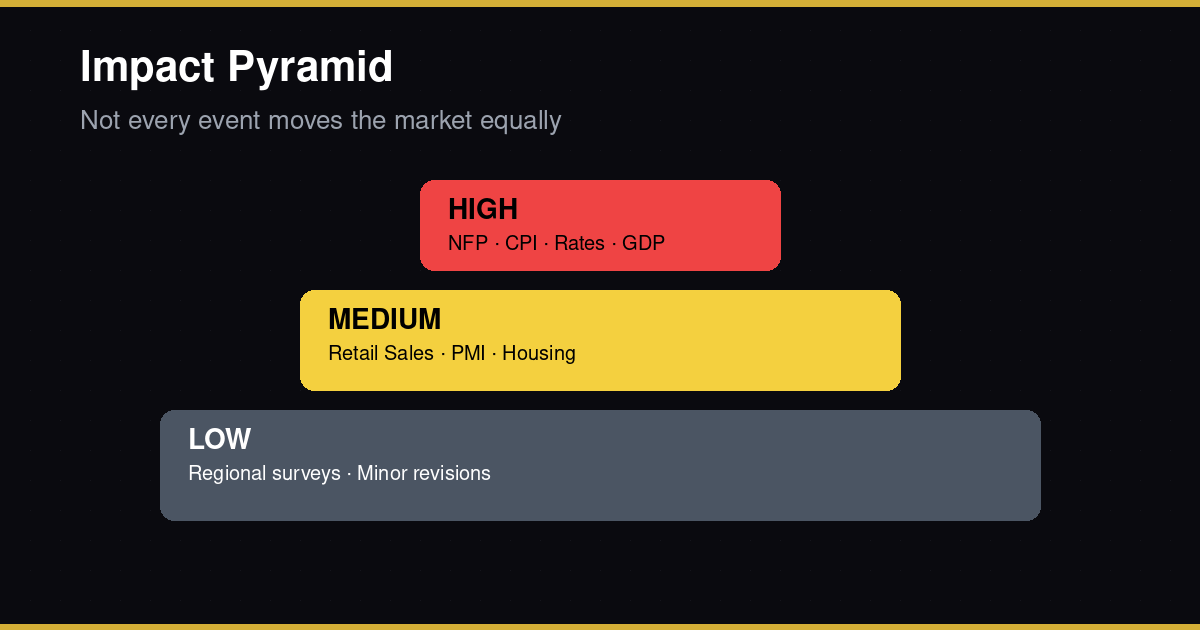
In reality, the impact of economic events follows something like a pyramid.
Market movers
Fed decisions, NFP, CPI, GDP, FOMC statements, ECB & BoE decisions — sharp volatility across asset classes.
Conditional influence
Retail Sales, Industrial Production, Durable Goods, Housing Starts, PMI, Consumer Confidence.
Usually noise
Minor regional surveys, secondary reports, small revisions — monitor without forcing a trade.
The important lesson is simple: an economic calendar is not just a list of events. It is a ranking of potential market-moving information.
Learning to distinguish between noise and meaningful information is one of the skills that separates experienced traders from beginners.
The Four Numbers Every Trader Must Understand
Open almost any professional economic calendar and you'll notice four columns beside each event.
Many beginners look only at the event title. Experienced traders often pay even more attention to these four numbers — they tell the real story.
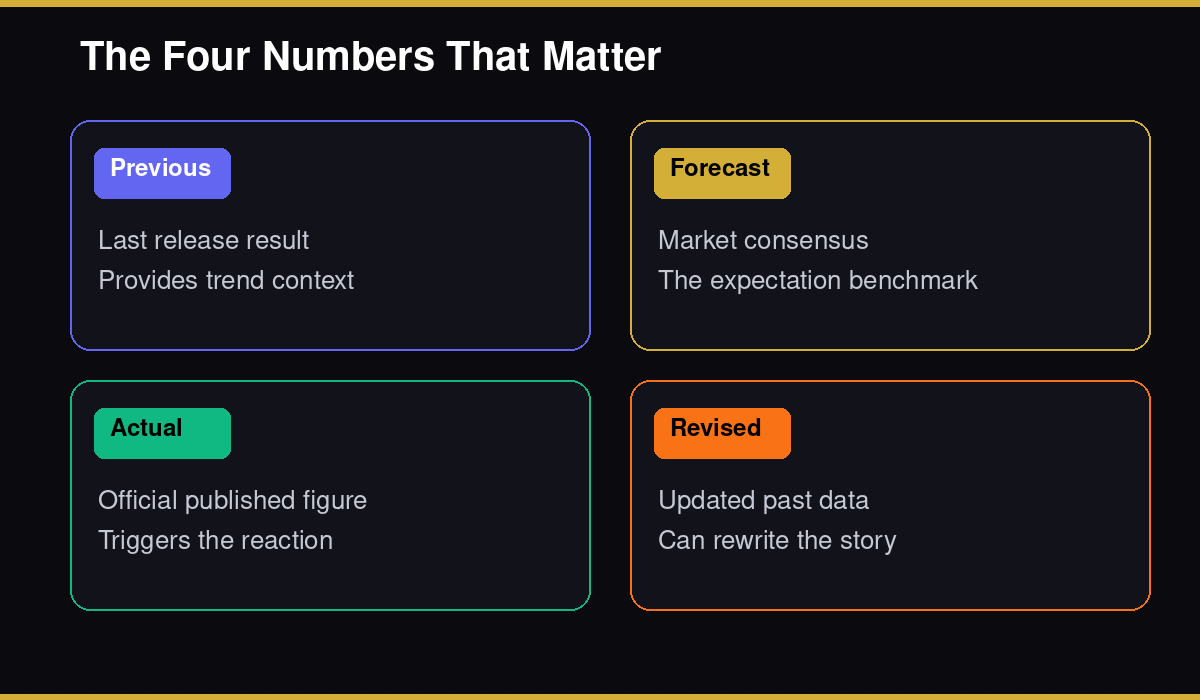
Previous
The Previous value is the result from the last time this report was released.
Suppose today's report is the monthly inflation rate. Last month's inflation was 2.9%. That number becomes today's Previous value.
On its own, the Previous figure doesn't tell you what the market expects next. But it provides context. Markets don't interpret economic data in isolation — they compare today's number with the recent trend.
If inflation has been rising steadily for six months, traders think differently than if inflation has been falling for six months. Economic data tells a story, and the Previous value is one of the earlier chapters.
Forecast
The Forecast is arguably the most important number before an announcement. It represents the market's consensus expectation.
Economists at banks, research firms, investment funds, and financial institutions publish their estimates before the official release. The average of these estimates becomes the market forecast.
The surprise principle
Markets usually react not to the economic number itself, but to how different it is from the forecast. A 3.1% print may sound high — but if everyone expected 3.1%, the market may hardly move.
Actual
The Actual value is the official figure released by the government or statistical agency.
Within milliseconds of publication, trading systems around the world compare the Actual value with the Forecast. If the difference is meaningful, buying and selling orders flood the market almost instantly.
This is why prices sometimes move before human traders have even finished reading the report. Today, algorithms often interpret economic releases in fractions of a second.
Revised
Many traders overlook the Revised column. That can be an expensive mistake.
Governments occasionally revise previously published data after collecting more complete information. Imagine last month's employment report originally showed 220,000 new jobs — then revised to 170,000. Suddenly, the economy doesn't look quite as strong as investors previously believed.
Sometimes the revision changes the market's interpretation more than today's headline number. Professional traders never ignore revisions.
Why the Difference Between Actual and Forecast Matters
Consider the following example.
| Event | Forecast | Actual |
|---|---|---|
| U.S. CPI | 2.8% | 2.8% |
Nothing surprising happened. Markets may remain relatively calm because investors received exactly what they expected.
Now consider another scenario.
| Event | Forecast | Actual |
|---|---|---|
| U.S. CPI | 2.8% | 3.3% |
The economy didn't suddenly change in one second. What changed was investors' expectations.
Higher-than-expected inflation increases the probability that the Federal Reserve may delay interest rate cuts — or even consider additional tightening if inflation proves persistent.
That single shift in expectations can strengthen the U.S. dollar, push bond yields higher, pressure stock markets, and weigh on gold prices.
Looking for real-time economic calendar data?
If you build a Forex platform, fintech dashboard, or trading tool, you don’t need to scrape websites. EconPulse delivers live macroeconomic events — with Actual, Forecast, Previous, impact levels, and multilingual titles — through a clean JSON API.
- Real-time & historical events
- High / Medium / Low impact filters
- Up to 23 languages
- Ready for brokers & algos
Which Markets Respond to Economic News?
One common misconception is that economic calendars are useful only for Forex traders.
In reality, nearly every financial market reacts to macroeconomic information. The magnitude and direction of the reaction simply vary from one asset class to another.
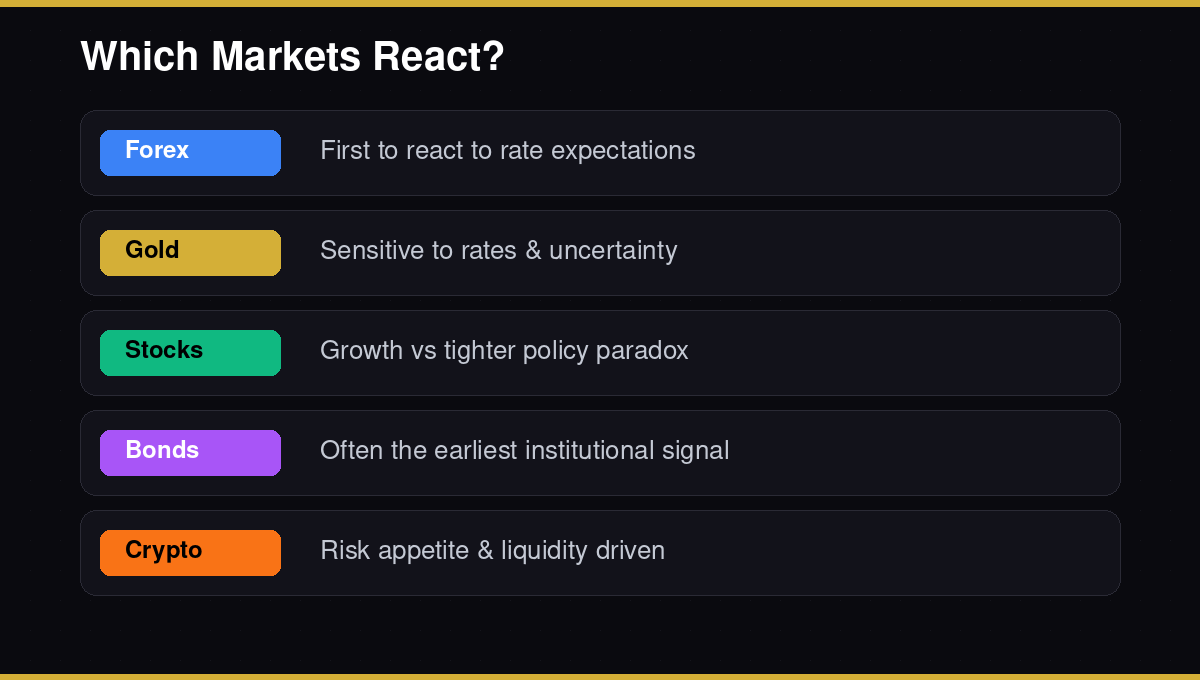
Usually first to react
Rate expectations change how attractive one currency is versus another — watch EUR/USD, GBP/USD, USD/JPY, AUD/USD.
Context-dependent
Higher rates can pressure gold; uncertainty can boost it. The same CPI print can lift or crush gold depending on the backdrop.
The paradox
Strong data can support earnings — or scare markets into expecting tighter policy. Good news isn't always good news.
Early signal
Often the most sensitive market. Pros watch yields before stocks or FX for how institutions interpret the print.
Liquidity & risk
Higher rates tend to reduce risk appetite; lower rates often do the opposite. Macro increasingly moves digital assets too.
Good news isn't always good news. The market is always looking one step ahead.
Timing Matters More Than Many Traders Realize
Imagine two traders with the same strategy, the same setup, and nearly the same entry price.
The only difference is timing.
The first trader opens twenty minutes before an important Federal Reserve announcement. The second waits until the press conference ends and volatility begins to stabilize.
Even though their market analysis is identical, their results may be completely different.
When matters as much as where
An economic calendar helps you avoid placing trades during periods when price movements are driven more by uncertainty than by market structure. That's not a guarantee of success — but it is a practical way to avoid unnecessary risk.
The Most Common Mistakes Traders Make When Using an Economic Calendar
Almost every trader checks the economic calendar. Far fewer know how to use it correctly.
The difference isn't access to information — it's interpretation.
Looking at the calendar only after opening a trade
A trader spots a setup, enters, then notices a major central bank decision in ten minutes. Closing abandons the plan; staying means accepting unplanned uncertainty. Pros check the calendar before the session — not last.
Treating every news event as equally important
Dozens of events can appear in a single day. Most won't change direction. Filter by asking: Which events are capable of changing market expectations? That shift eliminates a lot of noise.
Assuming good economic data always pushes prices higher
Impact depends on the environment. Strong employment into sticky inflation may push stocks down because tighter policy becomes more likely. Ask: How does this information change expectations?
Trading the headline without reading the details
GDP can beat expectations while consumer spending slows and inventories drive the print. Initial optimism may fade within minutes. Context matters.
Ignoring market positioning
A surprising report can still produce a muted or opposite move if everyone was already positioned the same way and chooses to take profits. Positioning helps explain “irrational” reactions.
Building a Daily Routine Around the Economic Calendar
The most effective traders don't keep an economic calendar open all day. They use it to prepare.
Before the trading session
Identify high-impact events, affected currencies/markets, release times in your timezone, consensus forecasts, and previous values. You're identifying periods of elevated risk — not making predictions yet.
Before entering any trade
Ask: Is an important announcement scheduled before I expect this trade to finish? If yes, reconsider timing. Waiting thirty minutes can transform the environment.
After the release
Don't rush to be first. Initial moves are often algorithmic and liquidity-driven. Letting volatility settle for a few minutes is frequently better than being early by a few seconds.
- Mark high-impact events on your session plan
- Convert release times to your local timezone
- Note Forecast vs Previous before the print
- Decide in advance whether to trade through the event
- Wait for spreads and liquidity to normalize after release
Want this calendar inside your product — live?
Power widgets, alerts, and dashboards with EconPulse. Filter by date, currency, country, and importance, then render the same Actual / Forecast / Previous fields traders rely on — without maintaining scrapers.
The Economic Calendar Is Not a Trading Strategy
One of the biggest misconceptions among beginners is that economic news tells them exactly when to buy or sell.
It doesn't.
An economic calendar is a source of information — not a complete trading system.
Think of it the way a pilot thinks about a weather forecast. The forecast doesn't determine the destination. It helps determine how safely the journey can be completed.
Likewise, traders combine economic information with:
- Technical analysis
- Market structure
- Trend analysis
- Risk management
- Position sizing
- Sentiment analysis
Used alone, it has limitations. Combined with a disciplined trading process, it becomes significantly more valuable.
Why Every Serious Trader Needs an Economic Calendar
Markets don't wait for traders to catch up. Information is released according to a schedule, whether you're watching or not.
Ignoring that schedule doesn't eliminate risk — it simply means you're choosing to face it blindly.
An economic calendar won't predict every market movement, guarantee profitable trades, or replace experience.
What it will do is help you answer questions every trader should ask before risking capital:
- Is today's market likely to be unusually volatile?
- Which events deserve my attention?
- Are expectations already priced in?
- Should I reduce exposure before an important announcement?
- Is this a good day to be aggressive — or a good day to be patient?
These questions rarely appear on a price chart. Yet they often determine the difference between disciplined trading and emotional decision-making.
Final Thoughts
The best traders understand that success isn't built on predicting every market move. It's built on making consistently better decisions.
An economic calendar is one of the simplest tools available, but also one of the most misunderstood.
Used correctly, it helps you prepare rather than react. It encourages planning instead of guessing. And it reminds you that markets move not only because of what happens — but because of what investors expected to happen.
Five-minute habit
Before your next session, spend just five minutes reviewing the economic calendar. Those five minutes may not produce your biggest winning trade — but they might save you from your biggest unnecessary loss.
Related articles
Need an Economic Calendar API?
Power Forex dashboards and fintech apps with multilingual macro event data — NFP, CPI, rates, and more.
Get API Key